
Miguel Taboada
The history of boxing in Africa runs from traditional fist-fighting such as Hausa dambe to the modern ring, where Senegal’s Battling Siki became the first African-born world champion in 1922. Since then Nigeria and Ghana have produced world champions, Kinshasa has hosted the most famous fight of the twentieth century, and African boxers have won Olympic medals from Rome to Atlanta.
Fighting with the fists is far older than the modern rules. Boxing appears among the sports of ancient Egypt, as we explain in Ancient Egyptian Sports: What the Tomb Paintings Show. This is the story of how Africa entered the modern ring.
Before the gloves: dambe and traditional fist-fighting
The best-known traditional form is dambe, the boxing of the Hausa people, practised across northern Nigeria, southern Niger and south-western Chad. A fighter strikes with one bound fist, the “spear”, and guards with the open hand. It grew up among the butchers’ guilds, who toured the villages at harvest time to challenge local fighters, and today it has organised leagues and a large online following. We describe it, with nine other games, in Sports Invented in Africa: 10 Ancient African Sports.
Modern boxing, with gloves, rounds and the Queensberry rules, reached Africa with the colonial powers in the late nineteenth and early twentieth centuries: in the barracks, mission schools and port cities of British and French Africa, and in the mining towns of South Africa.
1922: Battling Siki, the first African world champion
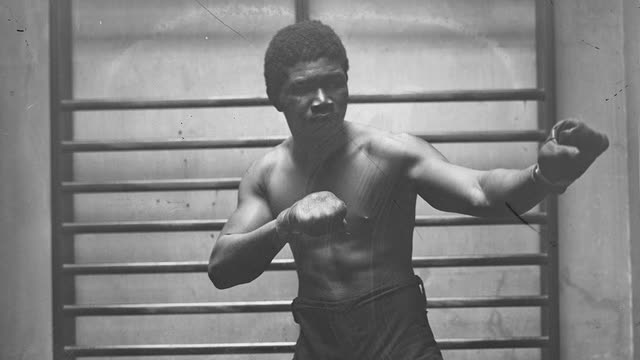
Amadou M’barick Fall was born in Saint-Louis, Senegal, and settled in France. Boxing as Battling Siki, he served in the French army in the First World War and then took on the French hero of the ring, Georges Carpentier.
On 24 September 1922, at the Stade Buffalo in Montrouge, just outside Paris, Siki knocked Carpentier out in the sixth round and became world light heavyweight champion, the first African-born boxer to win a world title. He lost the belt six months later, on 17 March 1923, to the Irishman Mike McTigue over twenty rounds in Dublin, on St Patrick’s Day. Siki died in New York on 15 December 1925, aged 28.
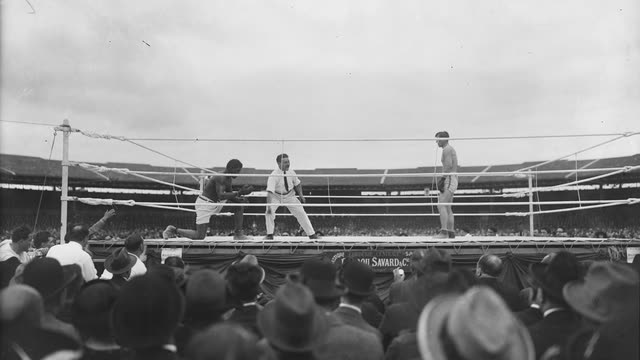
1957 to 1966: Nigeria’s world champions in Liverpool
Two of Africa’s first world champions built their careers in Britain, fighting out of Liverpool:
- Hogan “Kid” Bassey won the world featherweight title on 24 June 1957, stopping Cherif Hamia in the tenth round in Paris. He was the first boxer of Nigerian descent to become world champion, and later became a British citizen.
- Dick Tiger (Richard Ihetu), who moved his career to Liverpool in 1957, beat Gene Fullmer on points in San Francisco on 23 October 1962 to become world middleweight champion. On 16 December 1966 he beat José Torres at Madison Square Garden and added the world light heavyweight title. He died in Aba, Nigeria, on 14 December 1971.
Their careers belong to Black British history as much as to African history, like that of the Gold Coast-born footballer and sprinter in First Black Professional Footballer: Arthur Wharton.
1974: the Rumble in the Jungle
The most famous fight ever held in Africa did not involve an African boxer. On 30 October 1974, at the 20th of May Stadium in Kinshasa, in what was then Zaire, Muhammad Ali knocked out George Foreman in the eighth round to regain the world heavyweight title. The local crowd backed Ali, and its chant of “Ali, bomaye!” became part of boxing legend.
Olympic boxing: Africa’s first medals
For several newly independent nations, boxing brought the first Olympic medal in their history:
- 1920, Antwerp: South Africa’s Clarence Walker, born in Port Elizabeth, won the bantamweight gold.
- 1960, Rome: Clement Quartey won silver at light welterweight, Ghana’s first Olympic medal.
- 1964, Tokyo: Nojim Maiyegun won bronze at light middleweight, Nigeria’s first Olympic medal.
- 1968, Mexico City: Eridadi Mukwanga won silver at bantamweight, the first Olympic medal for Uganda in any sport.
- 1988, Seoul: Kenya’s Robert Wangila won the welterweight gold, still the only Olympic boxing title won by a boxer from sub-Saharan Africa outside South Africa.
- 1996, Atlanta: Hocine Soltani won the lightweight gold, Algeria’s first Olympic boxing title.
South Africa’s early golds were won under a whites-only system, and the country was barred from the Olympics after 1960 because of apartheid. The same years saw the first African medals on the track, which we follow in History of Athletics in Africa.
Azumah Nelson and the professional era
Ghana’s Azumah Nelson won featherweight gold at the 1978 Commonwealth Games in Edmonton. As a professional he knocked out Wilfredo Gómez in the eleventh round in San Juan on 8 December 1984 to win the WBC featherweight title, and went on to world titles at super featherweight. He is a member of the International Boxing Hall of Fame and is often described as the greatest boxer Africa has produced.
2023: Francis Ngannou and the new heavyweights
The latest chapter came from mixed martial arts. Francis Ngannou, born in Cameroon and a former UFC heavyweight champion, made his boxing debut against the world heavyweight champion Tyson Fury in Riyadh on 28 October 2023. He knocked Fury down with a left hook in the third round and lost a split decision over ten rounds, one of the most talked-about results of the year.
Why this history matters
Boxing history is usually told from London, Paris and New York. Seen from Africa, it looks different: a traditional sport that never died out, a Senegalese champion a century ago, Nigerian world champions who made their careers in Liverpool, and Olympic medals that were the first for their nations.
Claudine Boothe’s documentary The African History of Sport (2018) traces the African origins of Olympic and popular sports, and the series in development The African Origin of Sport gives one episode to the martial arts: boxing, stick fighting and wrestling.
Frequently asked questions
When did the history of boxing in Africa begin?
Fist-fighting is very old in Africa: boxing appears among the sports of ancient Egypt, and the Hausa have their own traditional boxing, dambe. Modern gloved boxing arrived with the colonial powers, and the first African-born world champion was Battling Siki in 1922.
Who was the first African world boxing champion?
Battling Siki, born Amadou M’barick Fall in Saint-Louis, Senegal. He won the world light heavyweight title by knocking out Georges Carpentier in Montrouge, near Paris, on 24 September 1922.
What is dambe?
Dambe is the traditional boxing of the Hausa people of northern Nigeria, southern Niger and south-western Chad. Fighters strike with one bound fist, the “spear”, and guard with the open hand.
Where did the Rumble in the Jungle take place?
At the 20th of May Stadium in Kinshasa, Zaire (today the Democratic Republic of the Congo), on 30 October 1974. Muhammad Ali knocked out George Foreman in the eighth round.
Which African boxers have won Olympic gold?
They include Clarence Walker of South Africa (Antwerp 1920), Robert Wangila of Kenya (Seoul 1988) and Hocine Soltani of Algeria (Atlanta 1996).
Bring these stories to the screen
Best UK Images makes documentaries about Black history, sport and culture, from The African History of Sport to Skin and Coal. You can watch our films, find resources for educators and material for the press. For screenings, licences or co-productions, write to projects@bukimage.com.