
Miguel Taboada
Ancient Egyptian sports included wrestling, running, archery, rowing, swimming, stick fighting, hockey-style ball games, juggling and board games such as senet. We know because the Egyptians painted and carved them: on the walls of the Middle Kingdom tombs at Beni Hasan, in the reliefs of the Step Pyramid at Saqqara and on royal stelae, more than a thousand years before the first recorded Olympic Games in Greece in 776 BC.
This guide goes through what the tomb paintings and inscriptions actually show, sport by sport, and what historians are cautious about. If you want the wider African picture, from Hausa boxing to engolo, read our overview of sports invented in Africa.
What sports did the ancient Egyptians play?
The World History Encyclopedia lists fishing, rowing, javelin throwing, boxing, wrestling, weightlifting and gymnastics among the popular sports of ancient Egypt, with field hockey as the most frequently played team game. Common people also played handball and held high-jump competitions. In short:
- Combat sports: wrestling, boxing and stick fighting.
- Athletics: running, including the king’s ritual run at the Heb-Sed festival, javelin and high jump.
- Royal sports: archery, chariot driving and hunting.
- Water sports: swimming, rowing and water jousting on the Nile.
- Ball games: a hockey-like game, handball and juggling.
- Mind sports: senet, mehen and hounds and jackals.
Wrestling: hundreds of pairs on the walls of Beni Hasan
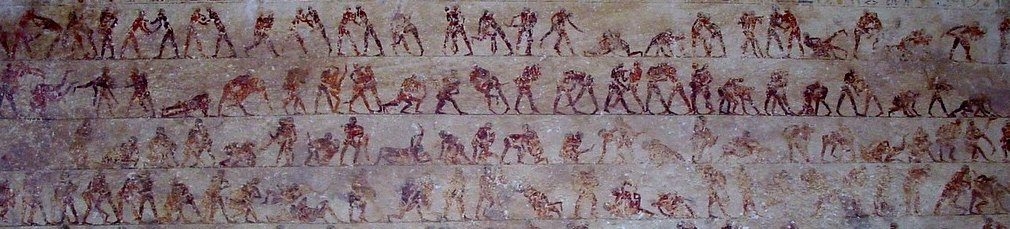
Wrestling is the best documented sport of ancient Egypt. At Beni Hasan, a cemetery of rock-cut tombs on the Nile in Middle Egypt, the governors of the early Middle Kingdom (around 2000 BC) had their walls covered with it. The east wall of the tomb of Baqet III (tomb 15) shows 220 pairs of wrestlers, one man in each pair painted red and the other dark brown so that the viewer can follow every hold. The tomb of Khety next door (tomb 17) has another 122 pairs, next to scenes of military training and an attack on a fortress.
Read in sequence, the pairs work almost like a flip-book: grips, lifts, trips and throws, many of them still recognisable in freestyle wrestling today. The setting next to soldiers and sieges also tells us why wrestling mattered: it was training for war as well as entertainment.
Running: the king’s race at the Heb-Sed festival
Running in ancient Egypt was tied to kingship. In the Heb-Sed (Sed festival), a jubilee normally held after a king’s first thirty years on the throne and repeated every three or four years after that, the king had to prove he was still fit to rule. An ebony label of the First Dynasty king Den shows him running around ritual boundary markers, and a relief in the underground galleries of Djoser’s Step Pyramid at Saqqara (Third Dynasty) shows Djoser running for the Heb-Sed. Djoser’s pyramid complex even has a Heb-Sed court with two boundary stones, symbolising his rule over Upper and Lower Egypt.
Running was also military training. Historians writing on the Kushite pharaoh Taharqa (Twenty-fifth Dynasty, 690–664 BC), a king from what is now Sudan, credit part of his army’s success to daily training in long-distance running.
Archery and rowing: the athlete king Amenhotep II
Archery was the sport of kings and nobles. The most famous royal athlete is Amenhotep II (reigned c. 1425–1401 BC). His stela by the Great Sphinx at Giza says that “there was not one there who could draw his bow, nor could he be approached in running”, and other texts claim he could shoot an arrow through a copper target a palm thick and row his ship faster and further than two hundred sailors. Egyptologists treat these boasts with some scepticism, but they show that physical excellence was part of what a pharaoh was expected to display. Ramesses II was also celebrated as an archer and hunter.
Stick fighting: from army drill to tahtib
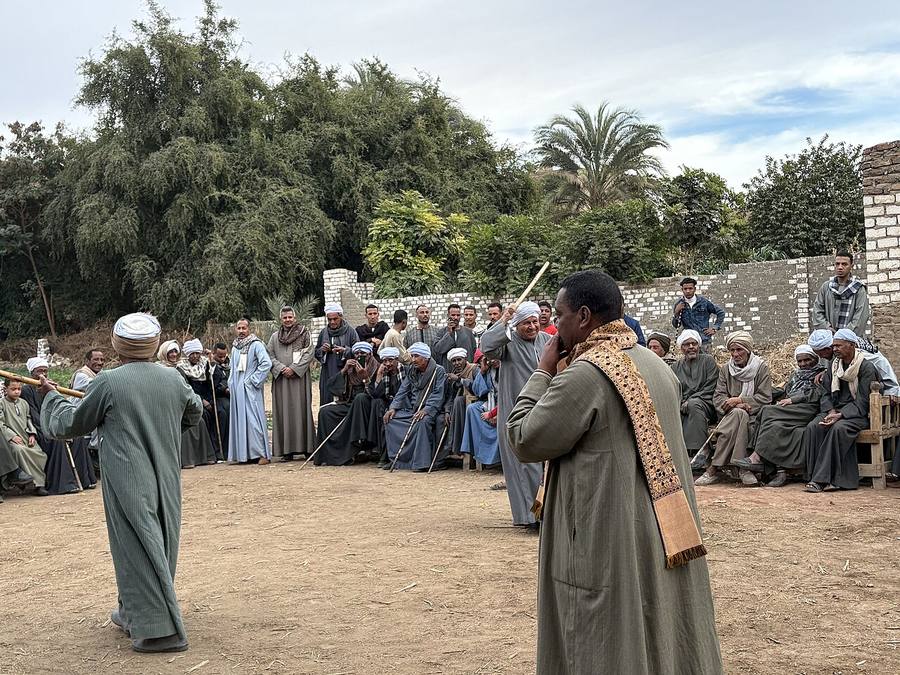
Stick fighting is one of the oldest Egyptian martial arts that is still practised. Reliefs from the pyramid of Sahure at Abusir (Fifth Dynasty, c. 2500 BC) appear to show soldiers training with sticks, alongside archery and wrestling. Three tombs at Beni Hasan contain stick-fighting scenes, and similar images appear at Tell el-Amarna (c. 1350 BC). By the New Kingdom it was also shown as a festive activity. Today it survives as tahtib, performed at weddings and festivals in Upper Egypt, from Luxor to Aswan.
Swimming, rowing and water jousting on the Nile
Life along the Nile made water sports natural. Egyptian sources mention rowing and swimming competitions, shooting the rapids and water jousting, in which crews in boats tried to push each other into the river with long poles. Children of the elite were taught to swim from an early age: a Middle Kingdom governor of Asyut (Siut) recorded in his tomb that he had taken swimming lessons with the king’s children.
Ball games, hockey, juggling and women in sport
The most frequently played team game looks very like hockey: players used palm branches with a curved end and a ball made of papyrus wrapped in leather or cloth. Smaller, sometimes dyed balls were used for juggling, and a painting at Beni Hasan shows girls juggling several balls at once. Girls and women also appear doing gymnastics and acrobatic dance, which makes ancient Egypt one of the earliest places where women are shown taking part in sport.
Board games: senet, mehen and hounds and jackals
Mind sports were just as popular. Senet, played by two people on a board of thirty squares, was played from the Early Dynastic Period until the Late Period; Queen Nefertari is painted playing it in her tomb, and it is mentioned in the Book of the Dead. Mehen, the “game of the snake”, was played on a round board shaped like a coiled serpent, though its rules are lost. Hounds and jackals, with pieces carved as dogs’ and jackals’ heads, was popular in the Middle Kingdom.
Why ancient Egyptian sport matters today
Ancient Egypt was an African civilisation, and its sporting record is one of the oldest in the world. The Beni Hasan wrestlers were painted some twelve centuries before the first Olympic Games, yet most textbooks still begin the history of sport in Greece. That gap is what Claudine Boothe’s work sets out to fill: her documentary The African History of Sport (2018) and the series in development The African Origin of Sport use tomb art and archaeology to trace modern sports back to Africa. It is also why we argue for decolonising the curriculum: who decides where history starts?
Frequently asked questions
What was the most popular sport in ancient Egypt?
Wrestling is the best documented: the tombs of Baqet III and Khety at Beni Hasan alone show 220 and 122 pairs of wrestlers. Among team games, a hockey-like game played with palm branches was the most frequent.
Did the ancient Egyptians have the Olympics?
Not under that name, but they held athletic tests and competitions long before Greece. The king’s ritual run at the Heb-Sed festival goes back to the First Dynasty, around 3000 BC, more than two thousand years before the first recorded Olympic Games in 776 BC.
Did women play sports in ancient Egypt?
Yes. Tomb paintings show girls juggling and performing gymnastics and acrobatic dance, and women also took part in swimming and rowing.
Is tahtib an ancient Egyptian sport?
Tahtib, Egyptian stick fighting, has roots in ancient military training: stick fighting appears in reliefs from around 2500 BC and in tombs at Beni Hasan. It is still performed today in Upper Egypt.
Which pharaoh was the greatest athlete?
Amenhotep II (c. 1425–1401 BC) is the best known. His Sphinx stela at Giza claims no one could match his archery or his running, although Egyptologists take these royal boasts with caution.
Bring these stories to the screen
Best UK Images makes documentaries about Black history, sport and culture, from The African History of Sport to Skin and Coal. You can watch our films, find resources for educators and material for the press. For screenings, licences or co-productions, write to projects@bukimage.com.