
Miguel Taboada
The history of rugby in Africa begins in Cape Town in 1862, with the first recorded match on the continent, and runs through a colour bar, decades of segregated competitions and international isolation to four South African world titles and Zimbabwe’s return to the World Cup in 2027. It is also a story of Black players who built their own rugby long before they could wear the national jersey.
Like cricket and football, rugby reached Africa with the British Empire; we tell those stories in History of Cricket in Africa: From 1808 to Lord’s 2025 and History of Football in Africa.
1862: how did rugby reach Africa?
In 1861 Canon George Ogilvie became headmaster of Diocesan College, the Cape Town school known as Bishops, and introduced a football game based on the one played at his old school, Winchester. In August 1862 he organised the first recorded match in South Africa, between the Army and the Civil Service at Green Point.
How much of that game was really rugby is still argued over: some historians see it as Ogilvie’s own creation rather than the Winchester game, and Rugby Football Union rules only took over later, as clubs spread across the Cape and inland.
1897: Black rugby and the Rhodes Cup
Rugby was never only a white game in South Africa. On 19 August 1897, at the Savona Café in Kimberley, delegates founded the South African Coloured Rugby Football Board, a national body for players of colour. Its early organisers included Bud Mbelle, who persuaded Cecil Rhodes to provide a trophy similar to the Currie Cup.
The first Rhodes Cup tournament was played in Kimberley in August 1898 and won by Western Province. It was replaced by the South Africa Cup in 1971. For most of the twentieth century Black, coloured and white rugby were run by separate boards, and only white players could be picked for the national team.
1906: the first Springboks
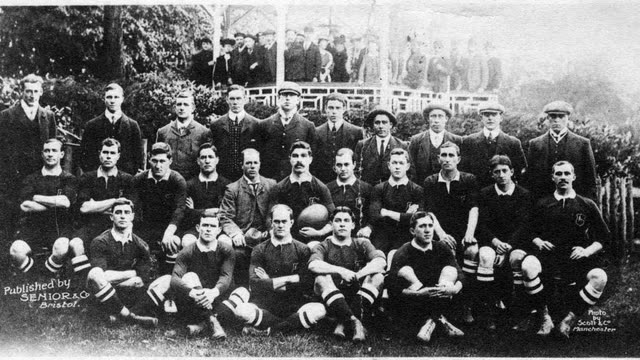
In 1906 a South African team toured Britain, Ireland and France, and on this tour the side became known as the Springboks: for decades one of the world’s strongest teams, and always whites-only.
1981: Errol Tobias and the years of isolation
As apartheid hardened, rugby became one of the most visible targets of the international boycott. In 1976 most African countries walked out of the Montreal Olympics because New Zealand’s rugby team had toured South Africa, a story we tell in History of Athletics in Africa.
On 30 May 1981 Errol Tobias, a centre from Caledon, made his debut against Ireland at Newlands and became the first Black player to represent South Africa. South Africa won 23–15. Some called his selection a token gesture, but it opened the door for Avril Williams and, later, his nephew Chester Williams.
South Africa was kept out of the first two Rugby World Cups, in 1987 and 1991. On 23 March 1992 the non-racial South African Rugby Union and the South African Rugby Board merged into a single body, the South African Rugby Football Union.
1995: Mandela, Ellis Park and Max Brito
Three years later South Africa hosted the World Cup. On 24 June 1995, at Ellis Park in Johannesburg, the Springboks beat New Zealand 15–12 in the first final to go to extra time. President Nelson Mandela, wearing a Springbok jersey with the number 6 of captain François Pienaar, handed him the Webb Ellis Cup, an image that became a symbol of the new South Africa. Chester Williams was the only Black player in the side.
The same tournament brought a darker moment. Ivory Coast, playing its first World Cup, met Tonga in Rustenburg on 3 June 1995. In the third minute the Ivorian winger Max Brito was caught under a collapsing ruck and left paralysed from the neck down. He died in France in December 2022.
Beyond South Africa: Zimbabwe, Namibia, Kenya and Madagascar
African rugby is much wider than the Springboks:
- Zimbabwe played at the first two World Cups, in 1987 and 1991. On 19 July 2025, in Kampala, the Sables beat Namibia 30–28 in the Rugby Africa Cup final to qualify for the 2027 World Cup in Australia, their first since 1991.
- Namibia played at every World Cup from 1999 to 2023, seven in a row, but has yet to win a match; its 142–0 defeat by Australia in 2003 is still the biggest margin in the tournament’s history.
- Kenya is Africa’s great sevens story. On 17 April 2016 the Shujaa beat Fiji 30–7 in the final of the Singapore Sevens, the country’s first Cup title on the World Series, with Collins Injera scoring two tries.
- Madagascar treats rugby as its national sport. World Rugby counts close to 40,000 registered players there, one of the biggest playing populations in the world, and a large share of them are women.
The continental body, launched in Tunis in 1986 as the Confederation of African Rugby, was renamed Rugby Africa in December 2014. By its fortieth anniversary in 2026 it represented about 40 nations.
2018–2023: Siya Kolisi and two more world titles
In 2018 Siya Kolisi, a flanker from the Eastern Cape, was named the first Black captain of the Springboks. He led South Africa to the World Cup in Japan, beating England 32–12 in Yokohama in 2019, and again in France, beating New Zealand 12–11 in Paris in 2023, the first captain to lift the trophy twice. With the titles of 1995 and 2007, South Africa has now won the World Cup four times, more than any other country.
Why this history matters
Seen from Africa, rugby is not only a story of public schools and the Home Nations: it is also the story of Bud Mbelle, Errol Tobias, Chester Williams and Max Brito. Claudine Boothe’s documentary The African History of Sport (2018) traces the African roots of Olympic and popular sports, and the series in development The African Origin of Sport takes the story further. For the games played on the continent long before rugby arrived, see Sports Invented in Africa: 10 Ancient African Sports.
Frequently asked questions
When did the history of rugby in Africa begin?
The first recorded match on the continent was played at Green Point, Cape Town, in August 1862, between the Army and the Civil Service. It was organised by Canon George Ogilvie, headmaster of Diocesan College, using a football code he had introduced to the school in 1861.
Who was the first Black Springbok?
Errol Tobias, a centre from Caledon, made his Test debut against Ireland at Newlands on 30 May 1981, becoming the first Black player to represent South Africa. South Africa won the match 23–15.
Why did South Africa miss the first two Rugby World Cups?
South Africa took no part in the 1987 and 1991 World Cups because of the international sporting boycott of apartheid. It returned as host of the 1995 tournament and won it, beating New Zealand 15–12 after extra time at Ellis Park on 24 June 1995.
Which African countries have played at the Rugby World Cup?
South Africa, champions in 1995, 2007, 2019 and 2023; Zimbabwe, in 1987 and 1991 and again qualified for 2027; Ivory Coast, in 1995; and Namibia, at every tournament from 1999 to 2023.
Is rugby popular in Africa outside South Africa?
Yes. Rugby is considered the national sport of Madagascar, which has around 40,000 registered players according to World Rugby. Kenya is a sevens power that won its first World Series title in Singapore in 2016, and Rugby Africa now has about 40 member nations.
Bring these stories to the screen
Best UK Images makes documentaries about Black history, sport and culture, from The African History of Sport to Skin and Coal. You can watch our films, find resources for educators and material for the press. For screenings, licences or co-productions, write to projects@bukimage.com.