
Miguel Taboada
The history of cricket in Africa begins in Cape Town in 1808, when British officers arranged the first recorded match on the continent, and runs through a colour bar, two decades of isolation and readmission to South Africa’s World Test Championship win at Lord’s in June 2025. Along the way Zimbabwe and Kenya produced some of the biggest shocks the game has seen, and new teams such as Namibia and Uganda have reached World Cups.
Cricket came to Africa with the British Empire, as football did; we tell that story in History of Football in Africa: From 1862 to Morocco 2022. But the African history of cricket is also a history of who was allowed to play, and who was kept out.
1808: how did cricket reach Africa?
The earliest record is a notice in the Cape Town Gazette announcing a match on Tuesday 5 January 1808 between the artillery mess and the officers of the Colony. The game spread from the garrison to the schools, clubs and towns of the Cape and Natal, carried by soldiers, teachers and colonial officials.
It did not stay a white game. In Cape Town, Malay and coloured cricketers formed their own clubs and teams; in 1892 a Combined Malay XI played the touring English side of Walter Read. South Africa played its first Test match against England at St George’s Park, Port Elizabeth, on 12–13 March 1889, although those early games were only recognised as Tests some years later.
1894: Krom Hendricks and the colour bar
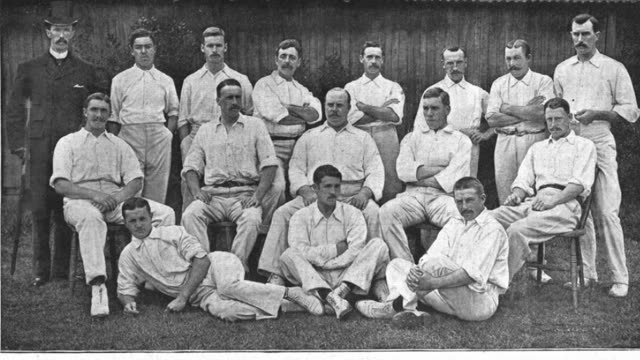
In the 1890s the fastest bowler in South Africa was Krom Hendricks, a Cape cricketer classified as “coloured”. When the selectors chose the first South African team to tour England, in 1894, he was left out. Political pressure from Cecil Rhodes led the organiser, Sir William Milton, to drop him; the official explanation was that including him would be “impolitic”.
For the next century South African Test cricket stayed whites-only, and Black, coloured and Indian cricketers played in separate competitions run by their own boards, however good they were.
1968: the D’Oliveira affair and two decades of isolation
Basil D’Oliveira was one of the cricketers that system shut out. Classified as Cape Coloured, he could never play for his country, so he moved to England around 1960 and made his Test debut for England in 1966.
In August 1968 he was left out of England’s squad to tour South Africa, despite scoring a century against Australia at The Oval that month. On 16 September he was called up to replace the injured Tom Cartwright. The South African Prime Minister, B. J. Vorster, said the team would not be accepted with D’Oliveira in it, and on 24 September 1968 the MCC cancelled the tour.
South Africa played its last Tests in 1970 and was then shut out of international cricket until 1991. Other sports followed the same path: in 1976 most African countries boycotted the Montreal Olympics over a rugby tour of South Africa, a story we tell in History of Athletics in Africa.
1991: readmission and the first Black Test cricketer
As apartheid was dismantled, South Africa returned to the international game in 1991. Its first match back was a one-day international against India at Eden Gardens, Calcutta, on 10 November 1991, and a few months later the team reached the semi-finals of the 1992 World Cup.
Makhaya Ntini, a fast bowler from the Eastern Cape, made his one-day debut against New Zealand on 16 January 1998 and his Test debut against Sri Lanka on 19 March 1998, becoming the first Black South African to play Test cricket for his country.
Zimbabwe and Kenya: Africa’s giant-killers
Elsewhere, Africa produced some of the great World Cup upsets:
- 9 June 1983, Trent Bridge: in its first World Cup match, Zimbabwe, captained by Duncan Fletcher, beat Australia by 13 runs.
- October 1992, Harare: Zimbabwe, granted Test status that July, played its first Test against India at Harare Sports Club.
- 29 February 1996, Pune: Kenya bowled out West Indies for 93 and won by 73 runs.
- 2003, southern and eastern Africa: South Africa, Zimbabwe and Kenya co-hosted the World Cup, and Kenya reached the semi-finals, the only team without Test status ever to do so, before losing to India.
The 2003 tournament is also remembered for a protest. Zimbabwe’s Andy Flower and Henry Olonga wore black armbands in their opening match, “mourning the death of democracy” in their country.
2025: Lord’s, and a new generation
Temba Bavuma became South Africa’s first Black African captain, of the one-day side in 2021 and of the Test side in 2023. In June 2025 he led South Africa to victory over Australia by five wickets in the World Test Championship final at Lord’s, the country’s first ICC title since 1998. Later that year the South African women reached the final of the 2025 Women’s World Cup, where they lost to India.
Elsewhere the game keeps growing. Namibia, which made its World Cup debut in 2003, reached the Super 12 stage of the T20 World Cup in 2021, and Uganda played its first T20 World Cup in 2024. The next 50-over World Cup, from 2 October to 21 November 2027, will be shared by South Africa, Zimbabwe and Namibia.
Why this history matters
Cricket is usually told as an English game that the Empire exported. Seen from Africa, it is also the story of Krom Hendricks and Basil D’Oliveira, of players who were good enough but the wrong colour, and of a generation that finally lifted a trophy at Lord’s with a Black African captain.
Claudine Boothe’s documentary The African History of Sport (2018) traces the African roots of Olympic and popular sports, and the series in development The African Origin of Sport takes the story further. For older games played on the continent long before cricket arrived, see Sports Invented in Africa: 10 Ancient African Sports.
Frequently asked questions
When did the history of cricket in Africa begin?
The first recorded match in Africa was arranged in Cape Town for 5 January 1808, between British army officers. South Africa played its first Test match against England at Port Elizabeth on 12–13 March 1889.
Who was Krom Hendricks?
A Cape fast bowler of the 1890s, classified as coloured and considered the fastest bowler in South Africa. He was left out of the 1894 tour of England because of his race, after political pressure from Cecil Rhodes.
What was the D’Oliveira affair?
In September 1968 England picked Basil D’Oliveira, a Cape Coloured cricketer who had emigrated to England, for its tour of South Africa. Prime Minister B. J. Vorster refused to accept him, and the MCC cancelled the tour on 24 September 1968.
When was South Africa banned from international cricket?
South Africa played no international cricket between 1970 and 1991 because of apartheid. It returned with a one-day international against India in Calcutta on 10 November 1991.
Which African countries play Test cricket?
South Africa, which played its first Test in 1889, and Zimbabwe, which gained Test status in July 1992.
Bring these stories to the screen
Best UK Images makes documentaries about Black history, sport and culture, from The African History of Sport to Skin and Coal. You can watch our films, find resources for educators and material for the press. For screenings, licences or co-productions, write to projects@bukimage.com.