
Miguel Taboada
The first African Olympic gold medalist is usually named as Abebe Bikila of Ethiopia, who won the marathon barefoot in Rome on 10 September 1960 and became the first Black African Olympic champion. He was not, however, the first Olympic champion from the African continent: South Africa’s Reggie Walker won the 100 metres in London in 1908, and the Algerian-born Boughera El Ouafi won the marathon for France in 1928. The right name depends on the question.
Here are the three “firsts”, and the story of the man the world remembers.
Who was the first African Olympic gold medalist?
There are three answers, depending on the definition:
- An early Olympic champion from Africa: Reggie Walker (1908). Born in Durban in 1889, Walker won the 100 metres at the London Olympics in 10.8 seconds, equalling the Olympic record. Aged 19 years and 128 days, he was still the youngest winner of the Olympic 100 metres as of 2021.
- First African to win the Olympic marathon: Boughera El Ouafi (1928). Born in French Algeria, El Ouafi was a Renault factory worker when he won the marathon at the Amsterdam Olympics, 26 seconds ahead of Chile’s Manuel Plaza. He ran for France, and the French press played his victory down because of his Algerian origin.
- First Black African Olympic champion: Abebe Bikila (1960). He won Ethiopia’s first Olympic gold medal and the first ever won by an athlete from Black Africa.
Black Africans had taken part in the Games long before that. At St Louis in 1904, two Tswana runners, Len Taunyane and Jan Mashiani, ran the marathon: the first Black Africans to compete at the modern Olympics. It took another 56 years for a Black African to win.
Abebe Bikila: from the Imperial Guard to Rome
Abebe Bikila was born on 7 August 1932 in Jato, Ethiopia, on the day of the 1932 Olympic marathon. As a boy he played gena, a traditional Ethiopian stick-and-ball game in which the goals could be kilometres apart. Around 1952 he joined the Imperial Guard in Addis Ababa, the elite unit that protected Emperor Haile Selassie.
There he came to the attention of Onni Niskanen, a Swedish coach employed by the Ethiopian government to train the Guard. In the summer of 1960 he won two marathons in Addis Ababa, the second in 2:21:23, faster than the Olympic record set by Emil Zátopek.
Barefoot in Rome, 10 September 1960
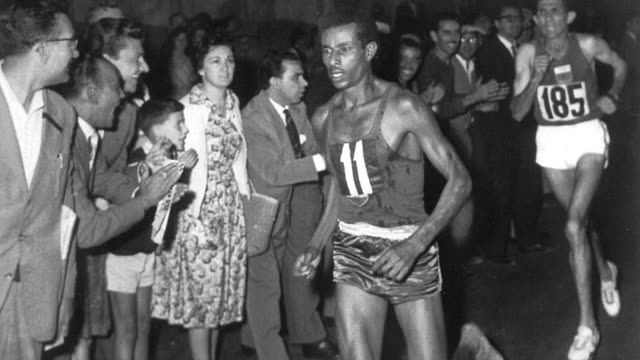
In Rome, the new running shoes Abebe bought did not fit and gave him blisters, so he decided to run without them. Because of the heat, the race started in the late afternoon at the Capitoline Hill and finished after dark at the Arch of Constantine, beside the Colosseum, along an Appian Way lit by soldiers holding torches.
The route had a meaning of its own. Twice it passed the Obelisk of Axum, a 4th-century Ethiopian stele that Italian forces had taken to Rome as a spoil of war in 1937, during the occupation of Ethiopia. Abebe ran stride for stride with Morocco’s Rhadi Ben Abdesselam until the last 500 metres, then pulled away near the obelisk.
He won in 2:15:16.2, 25 seconds ahead of Ben Abdesselam, beating the world best of the Soviet runner Sergei Popov by eight tenths of a second. Barry Magee of New Zealand took bronze. At the line Abebe began touching his toes and jogging on the spot; he said later that he could have run another 10 to 15 kilometres.
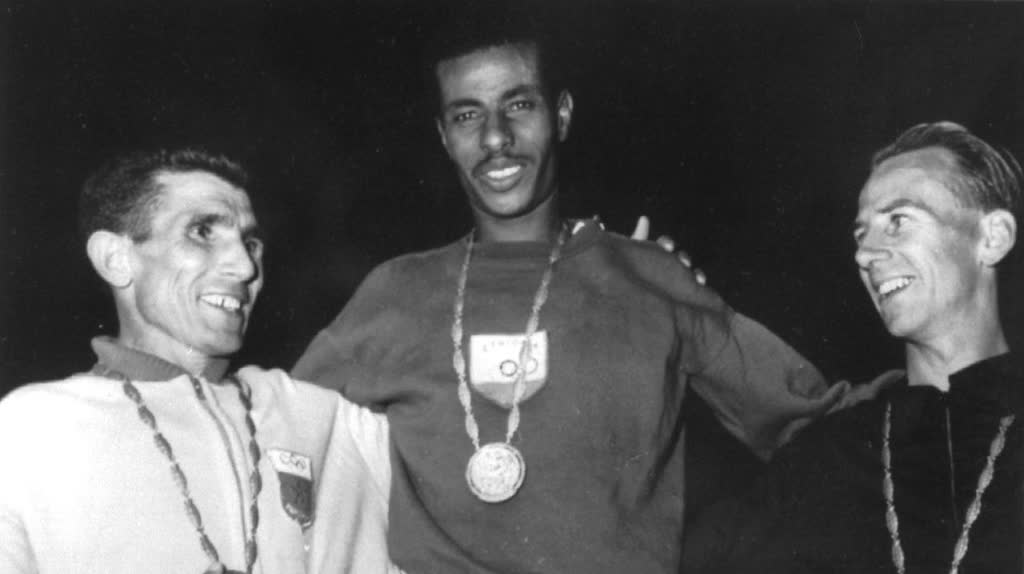
Tokyo 1964: the first to win the Olympic marathon twice
Forty days before the Tokyo Games, Abebe was diagnosed with acute appendicitis and operated on, on 16 September 1964. On 21 October, this time wearing shoes, he entered the Olympic stadium alone, in front of 75,000 spectators, and won in 2:12:11.2, more than four minutes ahead of Britain’s Basil Heatley.
It was another world best, and it made him the first athlete to defend an Olympic marathon title.
After the Olympics: Mexico, Stoke Mandeville and Addis Ababa
At Mexico City in 1968, wearing bib number 1, Abebe went for a third title, but a fractured fibula forced him out after about 16 kilometres. His team-mate and fellow Guardsman Mamo Wolde won the race.
On 22 March 1969 Abebe was badly injured when his car overturned, and he never walked again. He spent eight months being treated at Stoke Mandeville Hospital in Buckinghamshire, and in July 1970 he competed in archery and table tennis at the Stoke Mandeville Games, an early forerunner of the Paralympics.
Abebe Bikila died in Addis Ababa on 25 October 1973, aged 41, from a brain haemorrhage linked to the accident. An estimated 65,000 people attended his state funeral.
The African champions who followed
Abebe opened the door for what the writer Kenny Moore called “the great African distance running avalanche”:
- Mamo Wolde (Ethiopia) won the marathon in Mexico City in 1968.
- Naftali Temu won the 10,000 metres at the same Games, Kenya’s first Olympic gold medal.
- Nawal El Moutawakel (Morocco) won the first women’s 400 metres hurdles at Los Angeles in 1984, the first African woman to become Olympic champion.
- Derartu Tulu (Ethiopia) won the 10,000 metres at Barcelona in 1992, the first Black African woman to win Olympic gold, and won it again in Sydney in 2000.
Why the story matters
Abebe Bikila’s gold is often told as a story about bare feet, but it belongs to a much longer history: running, wrestling and ball games were part of African life thousands of years before the modern Olympics, as we explain in Sports Invented in Africa: 10 Games with Ancient Roots.
It also echoes the story of the Ghanaian-born sprinter and goalkeeper told in First Black Professional Footballer: Arthur Wharton. Claudine Boothe’s documentary The African History of Sport (2018) traces the African origins of Olympic and popular sports and pays tribute to the athletes who challenged the notion of racial supremacy.
Frequently asked questions
Who was the first African Olympic gold medalist?
Abebe Bikila of Ethiopia, winner of the marathon in Rome in 1960, is the first Black African Olympic champion. Africa had Olympic champions before him, among them South Africa’s Reggie Walker, who won the 100 metres in London in 1908.
Why did Abebe Bikila run barefoot?
The new running shoes he bought in Rome did not fit well and gave him blisters, so he chose to run the 1960 Olympic marathon without shoes. In Tokyo in 1964 he ran, and won, wearing shoes.
How many Olympic gold medals did Abebe Bikila win?
Two: the marathon in Rome in 1960 (2:15:16.2) and in Tokyo in 1964 (2:12:11.2), both in world best times. He was the first athlete to win the Olympic marathon twice.
Who was the first African woman to win Olympic gold?
Nawal El Moutawakel of Morocco, in the 400 metres hurdles at Los Angeles in 1984. Ethiopia’s Derartu Tulu, 10,000 metres champion in Barcelona in 1992, was the first Black African woman to win Olympic gold.
Who were the first Black Africans to compete at the Olympics?
Len Taunyane and Jan Mashiani, two Tswana runners from South Africa, who ran the marathon at the 1904 Olympic Games in St Louis.
Bring these stories to the screen
Best UK Images makes documentaries about Black history, sport and culture, from The African History of Sport to Skin and Coal, with new series in development such as The African Origin of Sport. You can watch our films, find resources for educators and material for the press. For screenings, licences or co-productions, write to projects@bukimage.com.